
A French court has ordered freezing of an Indian government property in Paris on a plea by Devas shareholders who are seeking to enforce a USD 1.3 billion arbitration award over a cancelled satellite contract, according to the court order copy.

MoD dismissed the report saying it draws 'conjectural connection between tax exemption to a private company and procurement of Rafale jets'.

Britain's Cairn Energy Plc has dropped lawsuits against the Indian government and its entities in the US and other places and is in the final stages of withdrawing cases in Paris and the Netherlands to get back about Rs 7,900 crore that were collected from it to enforce a retrospective tax demand. As part of the settlement reached with the government to the seven-year old dispute over levy of back taxes, the company - which is now known as Capricorn Energy PLC - has initiated proceedings to withdraw lawsuits it had filed in several jurisdictions to enforce an international arbitration award which had overturned levy of Rs 10,247 crore retrospective taxes and ordered India to refund the money already collected. Two sources with direct knowledge of the matter said Cairn on November 26 withdrew the lawsuit it had brought in Mauritius for recognition of the arbitration award and took similar measures in courts in Singapore, the UK and Canada.

Merging tribunals may lead to administrative convenience, but pendency of cases is likely to increase

Unlike Reliance Jio's focus on 4G, it plans to segment the data market based on device prices and spectrum.
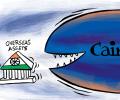
A New York court has paused Cairn Energy's pursuit of US assets of Air India for the recovery of $1.2 billion arbitral award, so as to allow the British firm to reach a settlement with the Indian government on the long drawn dispute. The New York district court delayed the tax suit to November 18, according to court documents reviewed by PTI. This follows Cairn Energy and Air India jointly asking the court to stay further proceedings in view of the fresh government enacting a fresh law to scrap retrospective taxation in the country.

The 30-share Sensex closed up 34 points at 27,831 and the 50-share Nifty ended up 15 points at 8,356.

However, survey by Japanese firm shows India as most preferred Asian market for Japanese investors.

Vodafone is facing tax liability over its $11 billion acquisition of a 67 per cent stake in the mobile-phone business owned by Hutchison Whampoa in 2007.

India's telecom sector has been through dizzying peaks, troughs, policy U-turns, court battles, brutal competition, and daily controversies. India could go back to a private sector duopoly with just Reliance Jio and Bharti Airtel surviving the mayhem. The third player, Vodafone Idea, could be history.

Siva group defaulted on payment in 2016 and is also facing CBI investigation

Vittorio Colao, who is currently on an India visit, said he would be open to listing his company in the country

Vodafone's long-pending tax dispute with the government might be heading for a resolution, with the finance ministry considering changing the Income-Tax Act's retrospective amendment and taxing indirect transfer of assets prospectively from 2012, the year the law was clarified.

'Our strategy should be to 'hold the line' in the north on the Sino-Indian land frontier, but maintain and, if possible, enlarge India's current edge in the maritime south.'

Arun Jaitley had a tough fiscal hill to climb.

If this Budget was not packaged and sold as a Budget for the poor and for farmers, Narendra Modi would have lost the next election.

The retrospective tax decision reversing the January 2012 Supreme Court verdict in the Vodafone case has often been cited as the reason for foreign investors losing confidence in India as an investment destination.

'After many rudderless years, India and Japan have prime ministers with a sense of purpose and direction,' says Brahma Chellaney.

There are a couple of proposals, however, whose goals are not easily achievable.

Given the relative rates of gross domestic product growth, the differential will increase.

The sluggish legal system in India makes it extremely difficult for law-enforcing agencies in the ministry of finance to punish violations of foreign exchange laws. Unfortunately, it is not just FEMA. The Prevention of Money Laundering Act too has significant infirmities, say Paranjoy Guha Thakurta and Pranati Mehra.
